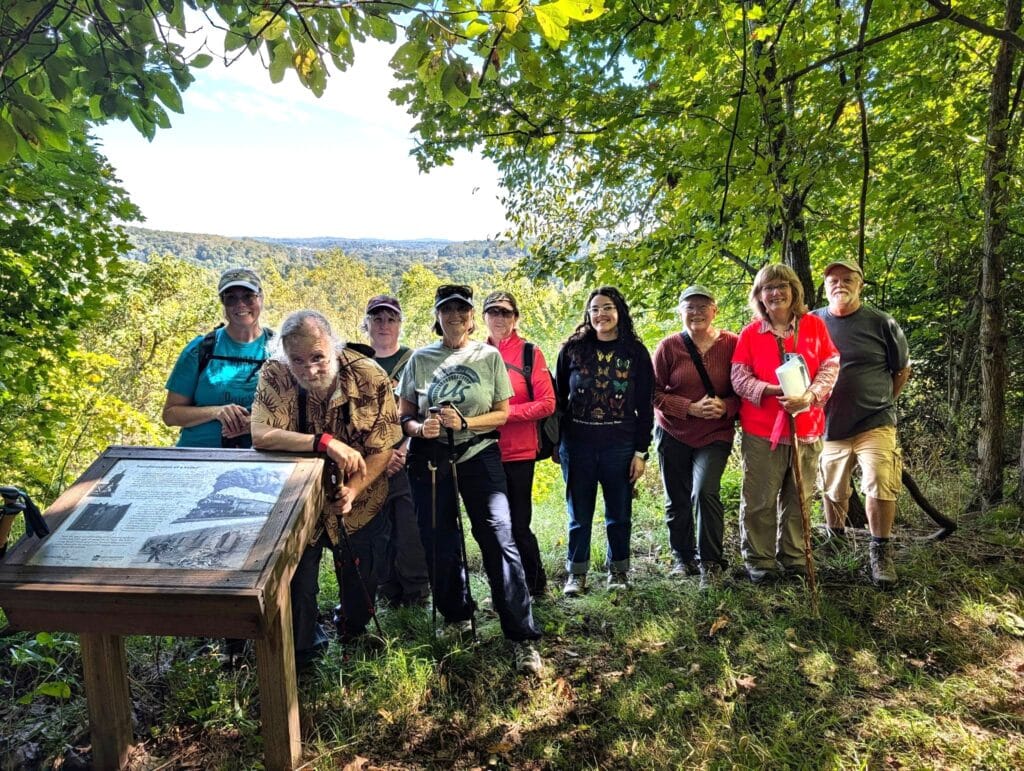
Westmoreland Land Trust was proud to serve as the host organization for the 2026 Westmoreland County Pennsylvania Master Naturalist training program, welcoming 12 participants over for an immersive 12-week educational experience based at St. Xavier Nature Preserve in Latrobe. From August through October, trainees explored Pennsylvania’s diverse ecosystems through classroom instruction, hands-on activities, and field experiences led by scientists, educators, and conservation professionals. The program covered a wide range of topics, including geology, botany, forest ecology, watersheds, wildlife biology, environmental stewardship, and more. Participants had opportunities to apply their growing knowledge in the field while discovering the ecological significance of protected natural spaces throughout western Pennsylvania.
Field trips were a highlight of the program, taking participants well beyond the classroom to explore the region’s remarkable natural landscapes. Early in the training, the cohort traveled to Tunnelton and Saltsburg to examine Pennsylvania’s geology firsthand. At Linn Run State Park and Spruce Flats Bog in Forbes State Forest, DCNR Environmental Educator Specialist Lisa Meadows guided trainees through aquatic and upland ecosystems, highlighting the differences between lowland and upland forests and introducing unique plants such as peat moss, St. John’s wort, and carnivorous pitcher plants. Closer to home, Carla Ruddock, Director of Conservation with Mountain Watershed Association, led a hands-on water quality investigation at Monastery Run, where participants collected and identified aquatic macroinvertebrates, including crayfish, riffle beetles, and caddisflies. Another memorable field experience brought the group to four Westmoreland Land Trust properties: St. Xavier Nature Preserve for bird observation and field sketching, Twin Lakes Meadow to explore pollinator habitat, Meadowlark Nature & Art Park to learn about its resident little brown bat maternity colony, and Ackermann Nature Preserve to experience its old-growth forest and search for reptiles and amphibians.
Throughout the program, an outstanding group of guest experts shared their knowledge and enthusiasm for the natural world. Dr. Mason Heberling, Curator of Botany at Carnegie Museum of Natural History, introduced trainees to plant ecology and the scientific importance of botanical specimens. Dr. Jim Kellam of Saint Vincent College explored ornithology, while Lane Potts of the Pennsylvania Game Commission and University of Pennsylvania’s Wildlife Futures Program provided insights into mammalogy and wildlife health. Andrea Kautz of Carnegie Museum of Natural History’s Powdermill Nature Reserve shared her expertise in entomology, and retired PennWest University professor Dr. Brian Paulson introduced participants to herpetology. Pam Curtin, Pennsylvania Master Naturalist and Director of Visitor Engagement at West Overton Village, helped trainees develop their observation and documentation skills through the iNaturalist project. During a session on suburban and urban ecology, Maeve Rafferty of Tree Pittsburgh demonstrated how trees help address urban heat, improve air quality, manage stormwater, and create healthier communities. The cohort’s final field trip included a visit to the Monastery Run Improvement Project, where Beth Bollinger of Saint Vincent College’s Chemistry Department explained efforts to address abandoned mine drainage and improve water quality in the Loyalhanna Creek watershed. At Duff Park in Murrysville, Pia van de Venne, founder of Friends of Murrysville Parks, and Dan Corrall guided participants through invasive plant identification and removal.
Beyond the knowledge gained, the program emphasized turning environmental education into meaningful conservation action. Pennsylvania Master Naturalist trainees complete 30 hours of volunteer service during their first year, applying their skills to projects that benefit local ecosystems and communities. Participants also connected with and were made aware of organizations offering volunteer opportunities. Westmoreland Land Trust is grateful to Pennsylvania Master Naturalist, our guest instructors and field trip partners, and especially the 12 trainees who devoted their time and energy to this experience. We are proud that St. Xavier Nature Preserve could serve as a center for environmental learning and look forward to seeing the lasting contributions these emerging conservation leaders will make throughout Westmoreland County and beyond.